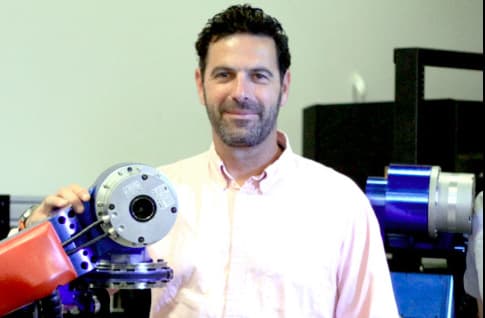
ME 250 Seminar Series: Dr. Jacob Rosen
About
Medical Robotics – Retrospective, Introspective, and Prospective Views and Impact on Human Health Jacob Rosen, Ph.D., Bionics Lab, Department of Mechanical and Aerospace Engineering, University of California, Los Angeles Abstract Over the past three decades, medical robotics has evolved from an engineering endeavor and proof of concepts into a transformative clinical technology, reshaping how surgeons operate inside the human body and how patients recover function after neurological injury. This talk offers a retrospective, introspective, and prospective examination of two intertwined branches of the field—surgical robotics and rehabilitation robotics—drawing on more than 30 years of research, in part, conducted at the Bionics laboratory and on parallel advances across the international research and commercial communities. The retrospective portion traces the trajectory from the earliest laparoscopic-assist systems of the late 1990s through the commercial dominance of master–slave teleoperated platforms, and from rudimentary passive motion devices to the emergence of multi-degree-of-freedom exoskeletons for upper- and lower-limb rehabilitation. I will revisit foundational contributions including the Raven open-architecture surgical platform, which catalyzed academic research in teleoperated and cooperative surgery, and the EXO-UL series of bilateral upper-limb exoskeletons, which established quantitative frameworks for understanding bimanual motor recovery following stroke. The introspective portion turns a critical lens on the field's current state. Despite remarkable clinical adoption, fundamental questions remain unresolved: How do we quantify the true clinical benefit of medical robotic beyond surrogate metrics? What are the challenges facing medical robotics in demonstrating consistent superiority over conventional treatment? The prospective portion looks forward to the next decade. I will argue that medicine in general goes through a revolution that is equivalent to the industrial revolution which are both sharing in common automation in in its modern version autonomous operation as a key function to provide high quality healthcare to a growing population under economic constrains. This effort give rise to a new generation of semi-autonomous and potentially full autonomous systems—surgical robots capable of context-aware assistance and rehabilitation robots that adapt continuously to a patient's neuromuscular state. Taken together, these perspectives outline a coherent vision in which medical robotics serves not as a replacement for clinical expertise but as a powerful amplifier of human capability—extending the reach of the surgeon, accelerating recovery for the patient, and ultimately broadening access to high-quality care across diverse populations and care settings.